



Noctavue Night Vision Goggles & Binoculars
Noctavue Night Vision Goggles & Binoculars
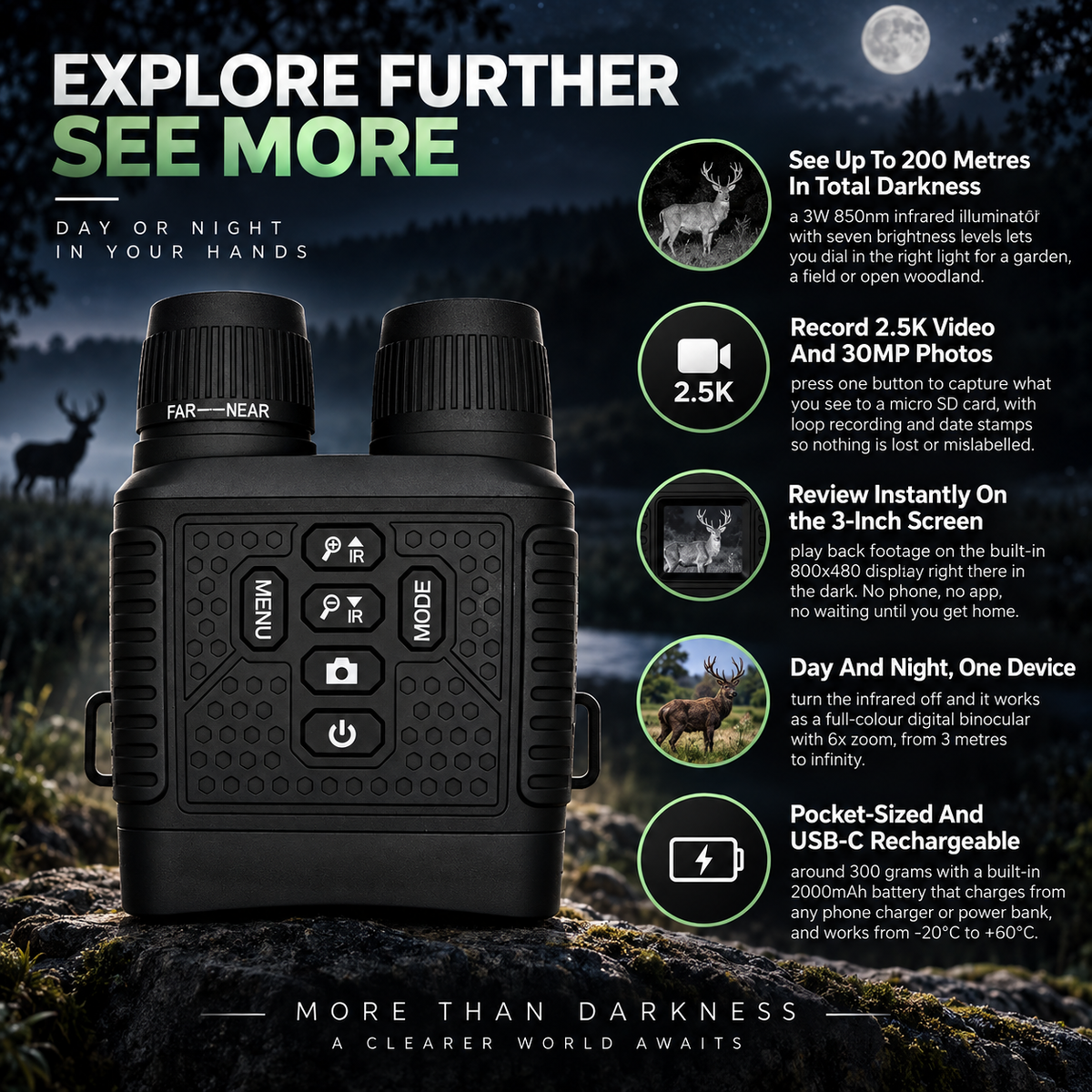
See up to 200 metres in total darkness, record 2.5K video and 30MP photos, and play it all back on a 3-inch screen — no torch, no phone, no app needed.
- 🌙 200 Metre Night Range - Seven infrared levels light up fields and gardens in complete darkness.
- 🎥 Records 2.5K Video - Captures 2.5K video and 30MP photos straight to a micro SD card.
- 📺 Built-In 3-Inch Screen - Watch what you have recorded on the spot, no phone or app.
- ☀️ Works In Daylight Too - Switch the infrared off and use it as colour binoculars with 6x zoom.
- 🔋 USB-C Rechargeable - Built-in 2000mAh battery charges from any phone charger or power bank.
Buy More & Save More
Couldn't load pickup availability
Noctavue Night Vision Goggles & Binoculars

Bought it to find out what was knocking the bins over at about two in the morning. Turns out it was a badger, and the footage from the back step was clear enough to show my daughter over breakfast the next day.


Why Everyone's Talking About the Noctavue Night Vision Goggles
A 3W 850nm infrared illuminator with seven levels and a 3-inch playback screen in one 300 gram handset — the reason people are seeing what moves through the garden at night.


Seven Levels Of Infrared Light
Dense woodland at dusk needs less light than an open field at midnight. Seven infrared levels let you dial in exactly enough, up to around 200 metres in total darkness, without a torch beam giving you away. The Noctavue F1.2 lens does the rest, pulling in every scrap of available light.

No Phone, No App, No Waiting
Most night vision cameras make you wait until you get home to see what you caught. This one has a 3-inch screen on the back. Press record, watch it back there in the dark, and know straight away whether it was the fox or the neighbour's cat. The Noctavue keeps it that simple.

One Device, Day And Night
Turn the infrared off in daylight and the same unit becomes a colour digital binocular with 6x zoom, focused from 3 metres to infinity with the manual wheel. The textured body sits comfortably in gloved hands and weighs around 300 grams. The Noctavue earns its place in the bag in every season.

Charges From Your Phone Cable
The built-in 2000mAh battery charges over USB-C from a phone charger or a power bank, so there are no AA batteries to run out at midnight. It records to micro SD cards up to 128GB with loop recording, and works from -20°C to +60°C. The Noctavue fits a coat pocket.
How to Use Your Noctavue
There is nothing to install, pair or set up. Charge it once over USB-C, slide in a micro SD card and hold the power button for two seconds. Turn the focus wheel until the screen is sharp, step outside and press the infrared button as it gets dark. The whole thing takes under a minute.
-

Insert The Card
Slide in a micro SD card and hold the power button for two seconds
-

Set The Infrared
Short press the up button to step through seven infrared levels as needed
-

Focus And Record
Turn the focus wheel until sharp, then press OK to capture video or photos
-

Charge And Repeat
Plug into USB-C overnight, and it is ready for the garden again tomorrow


Free Tracked Shipping!
Free Tracked Shipping!
Free Tracked Shipping!
Free Tracked Shipping!
Free Tracked Shipping!
Free Tracked Shipping!
Free Tracked Shipping!
Free Tracked Shipping!
Free Tracked Shipping!
Free Tracked Shipping!
Free Tracked Shipping!
Free Tracked Shipping!
Free Tracked Shipping!
Free Tracked Shipping!
Free Tracked Shipping!
Free Tracked Shipping!
Noctavue vs Others
200 metre night range, 2.5K recording and a built-in playback screen — here is how it compares with the other night vision binoculars out there.

|
Others | |
|---|---|---|
200 metre infrared range |
||
Seven infrared levels |
||
2.5K video and 30MP photos |
||
Built-in 3-inch playback screen |
||
Colour daytime mode with 6x zoom |
||
USB-C rechargeable battery |
||
Operates -20°C to +60°C |
||
UK returns and support |
We have the answers to all your questions
Frequently asked questions
What are night vision goggles actually for?
Seeing and recording what happens after dark: wildlife in the garden, livestock in the field, or a yard and driveway at night.
Do I need an app, a phone or a subscription?
No. Everything is recorded to a micro SD card and played back on the built-in screen. No account, no app, no fees.
Is this thermal imaging?
No. It is digital night vision with an infrared illuminator, which shows real detail rather than heat blobs. It cannot see through walls or window glass.
How does it charge?
Over USB-C from any phone charger or power bank. The 2000mAh battery is built in, so there are no AA batteries to replace.
How far can I see in the dark?
Up to around 200 metres in complete darkness with the infrared on, and from 3 metres to infinity in daylight.
Is it heavy to hold or carry?
Around 300 grams and 155 by 120 by 60 millimetres, so it sits in a coat pocket or rucksack side pouch.
Where can I use it?
Gardens, fields, woodland, campsites and yards. Keep it dry: it is not waterproof, and it cannot observe through window glass.
Is there anything I should be careful about?
Never point it at the sun. Check local wildlife regulations before using any night vision device outdoors, and keep it away from water.